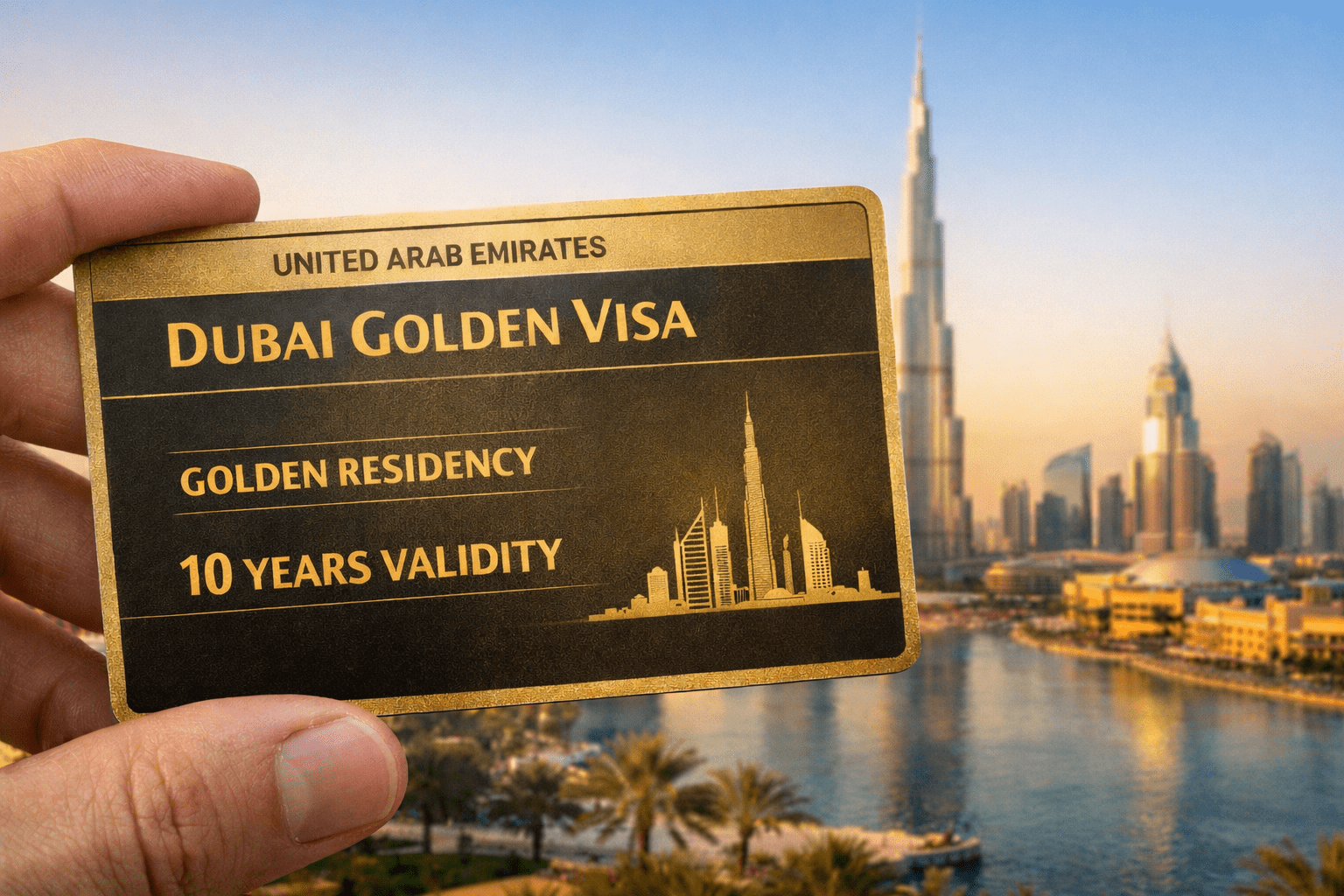
What the Dubai Golden Visa is — and how investors use it
Dubai Golden Visa is a long-term UAE residency framework designed for specific categories, including investors. For capital allocators, it’s not a lifestyle perk. It’s a residency structure that can support a longer operating horizon: property ownership, banking continuity, business set-up, and smoother administration over multi-year holding periods.
The right question is not “How do I get it?”
It’s: Does it improve my investment execution, risk control, or optionality?
Dubai Golden Visa in investor terms
For investors, the Golden Visa tends to be used for:
Holding assets with fewer residency frictions (admin continuity and renewals)
Executing a property strategy (buy-to-hold, yield-driven, or resale-led)
Relocation optionality (without committing to full-time residence)
Family residency planning (where applicable under the visa structure)
It is not a guarantee of returns, and it should not be the reason you buy an asset. It’s a secondary advantage that should sit behind your yield, liquidity, and exit model.
Who typically qualifies for the Dubai Golden Visa
Eligibility depends on the route. Common investor-relevant categories include:
Property-based investors
This route is built around real estate ownership that meets current criteria and documentation requirements.
Entrepreneurs and business owners
For founders and owners, this can relate to business activity, approvals, and recognised frameworks.
Highly skilled professionals and specialised talent
Relevant if you’re relocating for employment or professional practice (less relevant to a pure property investor, but important for mixed profiles).
Exceptional students and researchers
Not an investor pathway, but part of the overall Golden Visa ecosystem.
This article stays focused on investor logic: property-led and capital-structuring angles.
Investor decision framework: when a Golden Visa makes sense
A Golden Visa tends to be rational when it improves one or more of these:
1) Execution speed and operational continuity
If your strategy requires repeated travel, administrative processes, banking set-up, or ongoing asset management, long-term residency can reduce friction.
2) Holding period clarity
If you’re planning a multi-year hold, the visa can align with that timeline (rather than forcing short renewals and repeated paperwork cycles).
3) Family planning
If you’re structuring relocation optionality, dependants may factor into the decision model.
4) Risk management and documentation
Serious investors keep clean records. The Golden Visa process rewards that discipline (clear source of funds, clean ownership trail, documented transactions).
When the Dubai Golden Visa is not worth building your plan around
It often doesn’t add meaningful value when:
Your strategy is short-term flipping (your ROI should stand on its own)
You’re not planning to spend time in the UAE or build operational footprint
Your capital is better allocated to higher-liquidity, higher-demand segments rather than forcing a visa-driven purchase
You’re treating the visa as the primary reason for buying
A visa-led asset choice is a classic investor mistake: it pushes you toward suboptimal inventory.
Dubai Golden Visa routes investors should understand
This is the “map” you need before you make any commitments.
Route A: Property-led Golden Visa
This is the route most investors explore first: ownership, documentation, approvals.
What matters to investors:
Ownership structure (single vs joint)
Asset type and documentation quality
Clean valuation trail and payment records
Correct sequencing (purchase → paperwork → submission)
How ownership works for foreign buyers? read here.
Route B: Capital + business route
For investors who also run operating companies or hold active business roles, a business pathway can sometimes be more logical than forcing a property route.
What matters:
Approvals and eligibility proof
Business documentation integrity
Long-term compliance readiness
The clean investor process: how to approach it (5-step model)
Clarify your primary objective (yield, resale, relocation optionality, hybrid)
Choose the route (property-led vs business-led) based on your actual profile
Model all-in costs and timelines before committing capital
Structure the asset selection for liquidity first (not visa headlines)
Submit with “audit-ready” documentation to reduce delays and rework
This is how disciplined investors avoid expensive detours.
Cost and timeline: the two variables people underestimate
Golden Visa decisions often fail on two basics: true budget and timing.
What you should model (not guess)
Government/admin fees
Medical and ID-related steps
Document translation/attestation where relevant
Time-to-approval uncertainty
Any required buffers (so your capital isn’t trapped by process delays)
Risk control: compliance and staying flexible
Even if your strategy is “global investor, not full-time resident,” you still need to understand:
What ongoing compliance looks like
Practical rules around time outside the UAE
Renewal logic and documentation continuity
Conclusion: treat the Golden Visa like a structure, not a headline
The Dubai Golden Visa can be a strong tool when it supports an already-sound investment plan: clean asset selection, defensible demand, clear exit logic, and documented capital flow. The disciplined approach is simple: model first, execute second, optimise residency as a secondary advantage.
Dubai Gateway clients tend to get the best outcomes when the visa sits behind the strategy — not in front of it.
FAQs
1) What is the Dubai Golden Visa used for by investors?
Primarily for long-term residency continuity that supports multi-year property ownership, administration, and operational optionality.
2) Is the Dubai Golden Visa a reason to buy property?
It shouldn’t be the primary reason. The property must work on yield, liquidity, and exit first.
3) What are the main investor routes to a Dubai Golden Visa?
Most commonly property-led ownership routes, and in some cases business/entrepreneur pathways depending on the investor profile.
4) Does a Golden Visa reduce investment risk?
It can reduce operational friction, but it does not reduce market risk. Asset selection and exit planning still matter most.
5) What should I model before applying?
All-in costs, expected timeline, documentation readiness, and how the visa supports your holding period and exit plan.